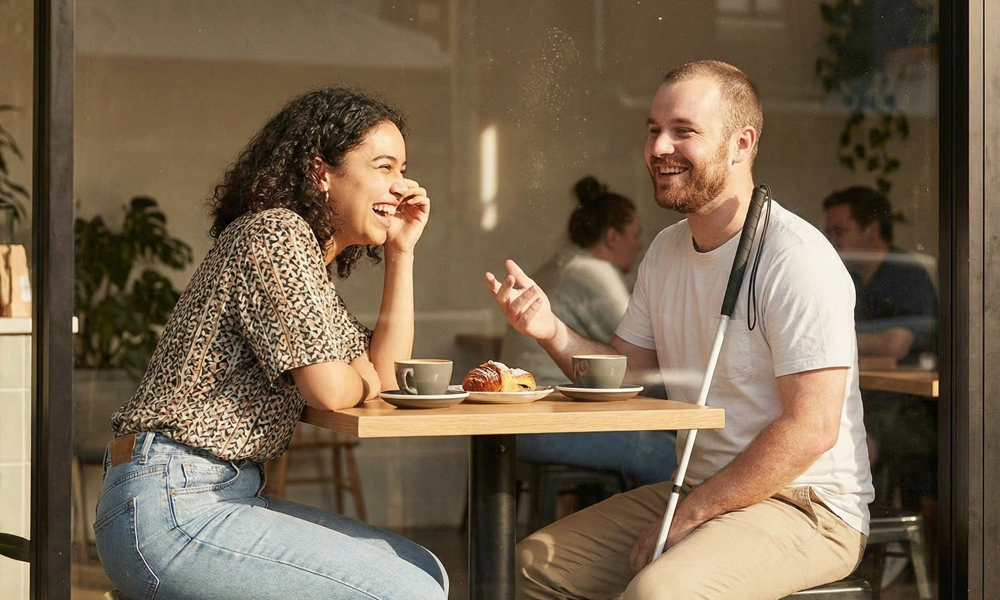
Let’s be honest: dating is complicated for everyone. Add vision impairment to the mix, and it introduces extra layers of consideration – from online dating profiles to first date logistics to building intimate relationships. But here’s the thing: vision impairment doesn’t make you undateable or less desirable. It simply means approaching romance with a bit more intentionality and self-awareness.
This guide explores the realities of dating and relationships as a vision-impaired Australian, from navigating dating apps to building lasting partnerships.
The Confidence Question
Before diving into practical strategies, let’s address the internal barrier that stops many vision-impaired people from dating: the belief that they’re somehow “less than” or that vision impairment makes them a burden in relationships.
This mindset is understandable – society sends constant messages about appearance, visual attraction, and independence as prerequisites for romance. But these messages are incomplete at best and harmful at worst.
The reality? People fall in love with personality, values, humour, intelligence, kindness, and countless other qualities that have nothing to do with vision. Yes, some people will be narrow-minded or uncomfortable. Those people aren’t your people. Let them self-select out of your dating pool and save you the trouble.
Your vision impairment is part of who you are, but it doesn’t define your worthiness of love and partnership. Approach dating from a place of self-worth, not apology.
Online Dating: The Modern Starting Point
Most Australian relationships now begin online, which presents both advantages and challenges for vision-impaired people.
Choosing Platforms
Different platforms have different accessibility features. Tinder, Bumble, and Hinge have made strides in screen reader compatibility, though none are perfect. Test a few platforms to see which works best with your assistive technology.
Some vision-impaired Australians prefer dating sites with more detailed written profiles (like eHarmony or RSVP) rather than swipe-based apps that prioritise photos. Detailed profiles let you showcase personality, interests, and values – your actual strengths.
Creating Your Profile
The disclosure question comes up immediately: do you mention vision impairment in your profile?
There’s no universal answer. Some people include it upfront: “I’m vision-impaired and navigate life with a white cane and a good sense of humour.” This approach filters out closed-minded people immediately and attracts those who appreciate honesty.
Others prefer mentioning it in initial conversations rather than in the profile itself. This is equally valid – your vision impairment is part of your story, but it’s not your opening line.
Whatever you choose, make your profile about you as a complete person. Lead with interests, passions, and personality, not medical information.
Profile Photos
Photos are tricky when you can’t see to check composition, lighting, or whether your eyes are looking at the camera. Ask trusted friends to help you choose flattering, genuine photos.
Include a mix: close-ups where your face is clear, full-body shots showing your personal style, and activity photos demonstrating your interests. If you use a white cane or guide dog, including them normalises your reality for potential matches.
Some vision-impaired people worry about eye appearance in photos – whether their eyes look “different” or don’t make direct camera contact. Here’s the truth: most people don’t notice or care as much as you think. And the ones who do care aren’t worth your time.
Navigating Conversations
Text-based conversations are actually easier for many vision-impaired people than in-person first meetings. You can take time to craft responses, use screen readers, and communicate without managing spatial navigation.
When and how to mention vision impairment depends on how the conversation flows. Some natural moments:
- They suggest a specific venue: “That sounds great – I should mention I’m vision-impaired, so well-lit places work better for me.”
- They ask about hobbies: “I love audio books” naturally leads to explaining why.
- They ask about your daily life: This is your opening to weave it into your story.
Be matter-of-fact, not apologetic. “I’m vision-impaired, so I use a cane/screen reader/guide dog” is information, not a confession.
Video Calls
Video calls before meeting in person have become standard, which can be anxiety-inducing when you can’t make direct eye contact or see your own image clearly.
Mention early in the call: “Just so you know, I’m vision-impaired, so I might not be looking directly at the camera.” Most people appreciate the heads-up and immediately relax about their own camera angles and appearances.
Focus on conversation quality rather than visual presentation. If they’re focusing solely on appearances rather than connection, they’re not the right match anyway.
Planning First Dates
The logistics of first dates require extra consideration when you’re vision-impaired, but this planning actually increases your chances of a good experience.
Choosing Venues
Suggest venues you’re comfortable navigating or have visited before. There’s zero shame in this – it’s strategic planning that allows you to focus on connection rather than logistics.
If your date suggests somewhere unfamiliar, research it beforehand. Check online reviews mentioning lighting, noise levels, and layout. Google Maps can provide street-level images to familiarise yourself with the exterior.
Ideal first date venues:
- Cafés or restaurants you’ve visited before
- Well-lit, not overly loud spaces
- Places with simple layouts
- Venues near accessible public transport
- Daytime settings where natural light helps
Transportation Considerations
Plan your route in advance. If you’re using public transport, know your connections and leave extra time. If you’re getting a rideshare, confirm the pickup location is clear and easy to navigate.
Some people prefer meeting at the venue rather than being picked up at home for first dates (safety and privacy). This is smart for everyone, not just vision-impaired people.
If your date offers to pick you up and you’re comfortable with this, be clear about any relevant details: “I’ll be the one with the white cane waiting near the front door” or “I have a guide dog who’ll be coming along.”
Managing Arrival
Arrive slightly early if possible. This gives you time to orient yourself, locate the bathroom, and settle in before your date arrives. You’re starting from a position of confidence rather than rushed disorientation.
If you arrive second, let your date know: “I’m just inside the entrance, near the host stand” so they can find you rather than you scanning the room trying to identify them.
The Disability Conversation
At some point during the first date, your vision impairment will probably come up more explicitly. This isn’t inherently negative – it’s just part of getting to know each other.
Keep it conversational, not medical. You’re sharing information about your daily life, not seeking pity or approval. Answer questions honestly but don’t feel obligated to provide your complete medical history.
Watch (or in your case, listen) for their response. Are they curious and respectful? Do they ask thoughtful questions about your experience? Or do they become awkwardly over-helpful or dismissive? Their reaction tells you a lot about whether they’re worth a second date.
Red Flags and Green Flags
Dating while vision-impaired requires the same discernment everyone needs, plus awareness of disability-specific warning signs.
Red Flags
- Treating you as inspirational for doing normal things (“You’re so brave for going on a date!”)
- Speaking to companions instead of you
- Assuming you can’t do things without asking
- Getting uncomfortable when you mention vision impairment
- Trying to “fix” your disability or suggesting miracle cures
- Fetishising your disability
- Making all decisions without consulting you
- Being embarrassed by your cane, guide dog, or assistive technology
Green Flags
- Asking directly how they can best help or accommodate
- Taking your lead on assistance
- Treating you as a complete person, not just a disability
- Being genuinely interested in your life experiences
- Comfortable with your assistive technology
- Willing to learn and adapt
- Seeing challenges as “our problem to solve together” rather than “your problem”
- Respecting your independence
According to research from People with Disability Australia, people with disabilities experience higher rates of relationship abuse than the general population. Trust your instincts. Anyone who makes you feel less-than, controlled, or infantilised isn’t the right partner, regardless of how “helpful” they claim to be.
Building Relationships
Once you’ve moved beyond first dates into actual relationship territory, different considerations emerge.
Interdependence vs Independence
Healthy relationships involve mutual support – everyone relies on their partner for some things. The key is maintaining balance and agency.
Yes, you might need your partner to drive sometimes, read small print, or help navigate unfamiliar places. That’s fine. They need you for other things – your emotional support, your problem-solving skills, your perspective, your partnership.
The problems arise when relationships become caregiving arrangements rather than partnerships. If your partner starts making decisions for you, speaking on your behalf, or treating you as someone to manage rather than an equal, that’s unhealthy.
Navigating Family and Friends
When relationships get serious, you’ll meet each other’s families. Some families are immediately accepting and curious. Others have misguided concerns: “How will they cope?” “Won’t that be too hard?” “What about the future?”
Your partner’s response to these questions matters enormously. Do they defend your capability and personhood? Do they educate patiently? Or do they share their family’s concerns?
You can’t control others’ reactions, but you can observe how your partner navigates these situations. Their response shows you how they truly view your relationship.
Intimacy and Physical Relationships
Vision impairment affects intimacy in some ways but not in the ways people assume. Physical attraction isn’t solely visual – touch, sound, scent, and emotional connection all create intimacy.
Communication becomes extra important. Without visual cues, you need to verbalise more: preferences, boundaries, needs. This actually creates stronger intimacy than assumptions based on body language.
Some practical considerations:
- Keep pathways to the bedroom clear
- Ensure lighting suits your needs (or darkness works fine too)
- Use verbal communication during intimate moments
- Store items consistently so you can locate them independently
- Don’t be self-conscious about touch-based exploration
Good partners understand that vision impairment doesn’t diminish desire, capability, or passion. It just means navigating intimacy somewhat differently.
Long-term Considerations
As relationships progress toward commitment, future planning conversations arise. Some vision-specific topics to discuss:
Living Arrangements: What home modifications might you need? How will you share household tasks based on each person’s strengths?
Career and Finance: How do your career paths and financial situations work together? If you receive disability support payments, how does relationship status affect this?
Transportation: How will you handle getting around as a couple? What’s realistic and what needs solutions?
Children: If you want children, what are the realities of parenting with vision impairment? (Many vision-impaired Australians successfully parent – it requires planning but it’s absolutely possible.)
Support Networks: How will you maintain support systems beyond just each other? Healthy relationships don’t isolate people from friends, family, and community.
These conversations aren’t unique to vision impairment – all couples need to discuss practical realities of building a life together. Vision impairment is simply one factor among many.
When Relationships End
Breakups are painful for everyone, but vision-impaired people face additional practical challenges when relationships end.
If you shared transportation or other supports, you’ll need to rebuild these systems independently. Reach out to Vision Australia or other support organisations to help you re-establish independence.
Emotionally, be wary of the narrative that the breakup happened because of your disability. Sometimes that’s true – some people can’t handle disability in a partner. But often, relationships end for the same reasons they end for everyone: incompatibility, different life goals, timing, or simply falling out of love.
Don’t let one person’s inability to see your worth make you question whether you’re dateable. You are. The right person will appreciate all of you, vision impairment included.
The Bigger Picture
Dating and relationships as a vision-impaired Australian require resilience, self-awareness, and confidence. You’ll encounter thoughtless people, awkward situations, and frustrating barriers. But you’ll also experience genuine connection, love, and partnership.
The Australian disability rights movement has fought hard for inclusion and accessibility in all areas of life, including romantic relationships. You have the right to love and be loved, to date and build partnerships, to experience romance on your own terms.
Your vision impairment doesn’t make you less attractive, less capable of love, or less worthy of partnership. It’s simply one characteristic among the complex, interesting person you are. The right people will see that (pardon the pun) and appreciate you for it.
Approach dating with realistic expectations but also with hope. Plenty of vision-impaired Australians have found love, built lasting partnerships, married, and created lives with people who value them completely. There’s no reason you can’t be one of them.